Scroll to content Scroll to footer

Sustainability.

Sustainability.

Sustainability is not an item on a to-do list that you can check off and then sit back. Rather, it is a journey that continually presents new challenges. We want to take you along on this journey, share our successes with you, but also clearly show which tasks still lie ahead of us. Transparency is our focus. We believe that honesty and trust are the most important foundation for conscious purchasing decisions. 

Here are a few things we're proud of:

Durable basics

Our products are timeless essentials designed to stay with you for as long as possible.

Communication

We want to communicate as transparently as possible about our sustainability efforts and regularly share insights into our progress and challenges.

Durable basics

Our products are timeless essentials designed to stay with you for as long as possible.

Communication

We want to communicate as transparently as possible about our sustainability efforts and regularly share insights into our progress and challenges.

Working conditions

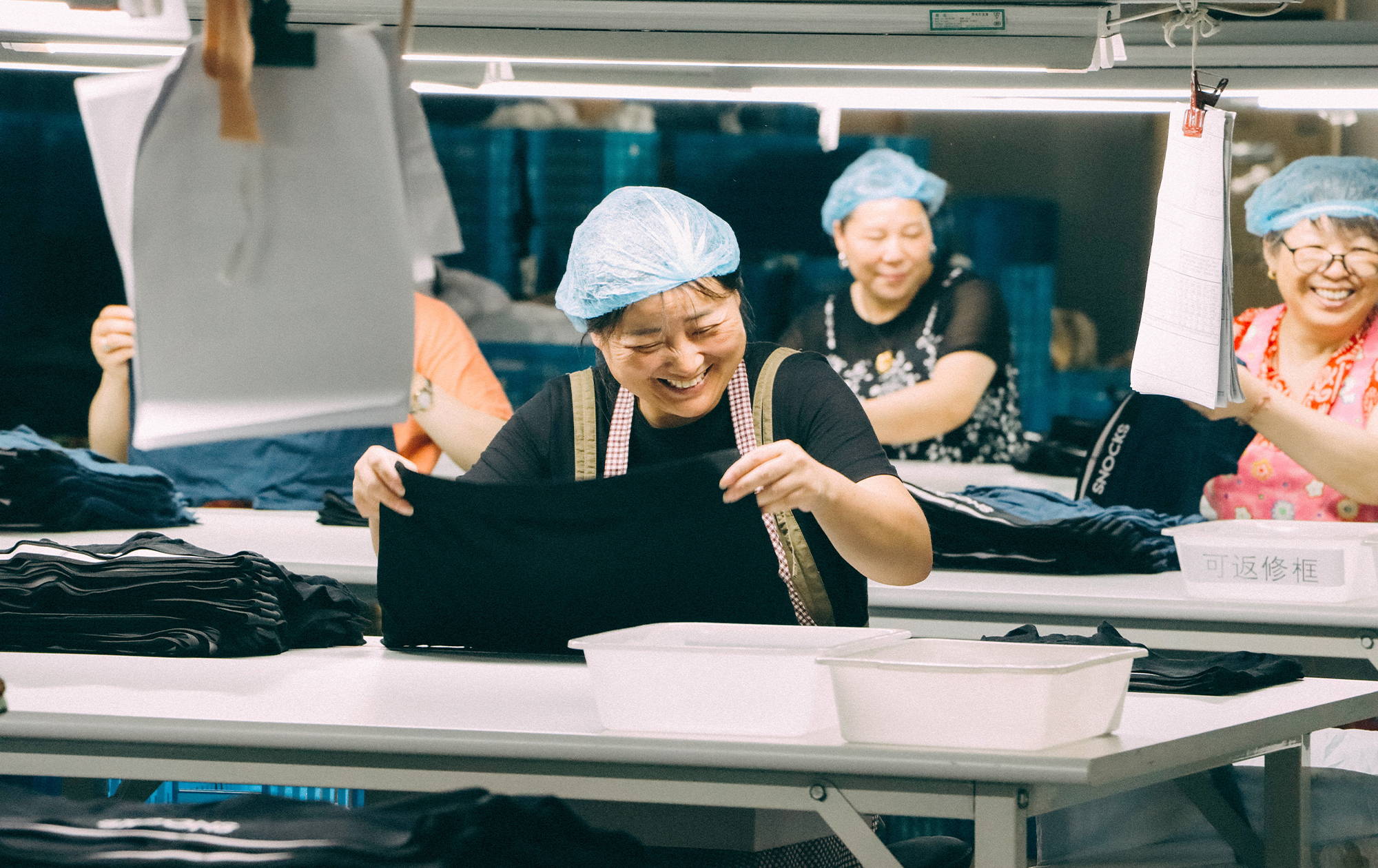
We address working conditions in our supply chain and work with production partners who are audited according to recognized social standards. We also collaborate with the Fair Wear Foundation, which supports us in systematically improving working conditions in the supply chain.

Materials

Around 78% of the fibers used in our product range are organic* cotton. The cotton we use is 100% organic* cotton.

*organic: grown using organic farming methods, without chemical-synthetic pesticides and fertilizers

Working conditions

We address working conditions in our supply chain and work with production partners who are audited according to recognized social standards. We also collaborate with the Fair Wear Foundation, which supports us in systematically improving working conditions in the supply chain.

Materials

Around 78% of the fibers used in our product range are organic* cotton. The cotton we use is 100% organic* cotton.

*organic: grown using organic farming methods, without chemical-synthetic pesticides and fertilizers

People & Supply Chain

Where and how our products are made matters to us. Here, we show you where we produce, who we work with, and what we are working on throughout our supply chain.

Learn more

People & Supply Chain

Where and how our products are made matters to us. Here, we show you where we produce, who we work with, and what we are working on throughout our supply chain.

Learn more

Environment & Climate

We produce basics - and leave traces along the way, in the office, in production, and during transport. Here we show how we measure our CO₂ footprint, where we stand, and what we are working on.

Learn more

Environment & Climate

We produce basics - and leave traces along the way, in the office, in production, and during transport. Here we show how we measure our CO₂ footprint, where we stand, and what we are working on.

Learn more

Materials & Products

Here you can learn what our products are made of - from the materials to the certifications behind them.

Learn more

Materials & Products

Here you can learn what our products are made of - from the materials to the certifications behind them.

Learn more

Care & Repair

Why throw things away when there’s another way? Here you’ll find tips on how to properly care for your basics, repair minor damage, and give them a second life.

Learn more

Care & Repair

Why throw things away when there’s another way? Here you’ll find tips on how to properly care for your basics, repair minor damage, and give them a second life.

Learn more

Who at SNOCKS is responsible for sustainability?

Hi, we are Lisa, Stefanie, Marie and Teresa - and together, this is our mission. Of course, we are not alone: the entire SNOCKS team is behind us, and together we want to get better step by step.

We would like to share an important tip with you: Every product leaves a footprint on this planet. Even though we do our best to minimize these footprints, the choice is ultimately yours: Buy only what you really need.

If you have any questions about this topic, feel free to email us at sustainability@snocks.com. We look forward to hearing from you.

And to get an even better understanding of what sustainability means at SNOCKS - watch the video!

7 quick questions & answers.

Is SNOCKS a sustainable company? 

We do not see ourselves as a sustainable company - because, like every manufacturing company, we consume resources and cause emissions.

Sustainability is therefore not a label or a state that you achieve once - but a journey on which we continue to develop step by step.


What this means in concrete terms: We take a close look at our daily work routine, for example, and try to improve it wherever we have a direct influence. Not perfect, but continuous.


A few examples from our offices:


🌏 Environment

100% electricity from renewable energy sources

Many small measures that we integrate into our working routine step by step: Less paper through digital solutions, effective waste separation, timers for lamps, reduced consumption of hygiene and consumable products through new dispensers, as well as kitchen and toilet paper from Goldeimer


💛 Together
 

Mental health support in collaboration with Nilo Health

Flexible working models such as remote work and three offices where furry friends are also welcome

A working environment that takes different needs into account - including accessible spaces and gender-neutral bathrooms in the Mannheim office.


For us, responsibility does not end in the office, however. Along our supply chain, we also systematically address social and environmental impacts. We continuously develop our material strategy and regularly assess where the use of recycled materials is technically possible and feasible.

We are also a member of the Fair Wear Foundation and systematically analyze our supply chain and the working conditions at our production partners. Once a year, as part of the Brand Performance Check, Fair Wear evaluates how we assess and improve working conditions in our supply chain. This is not proof of fair conditions, because perfection does not exist in global supply chains - but we can continue to develop our processes step by step.
Are SNOCKS products sustainable?

As a manufacturing company, our products and processes always leave an ecological and social footprint. That is precisely why sustainability is not a simple yes-or-no issue for us, but an ongoing process.

What we can say honestly is that we are continuously working to make our products more responsible. Depending on the product, we use GOTS- or OCS-certified organic* cotton as well as, wherever possible, GRS-certified recycled polyester and recycled polyamide. This is one of several measures we are taking to gradually address our environmental impact.

We also take a close look at social conditions throughout our supply chain. We collaborate with the Fair Wear Foundation and carefully examine our supply chain and the working conditions at our production partners.

Our approach to products also plays a role: We develop timeless basics that do not go out of fashion and can be worn for as long as possible.

Regarding transport: We predominantly use sea freight. According to the German Environment Agency, sea freight should be preferred to air freight for international goods transport, as transporting goods by plane releases up to 200 times more greenhouse gas emissions than transporting them by ship (source: German Environment Agency, umweltbundesamt.de/themen/gueterverkehr-der-zukunft-klimaneutral). Between January 1 and December 31, 2025, around 3.5% of our shipments were transported by air freight; this figure is based on internal data from our order and logistics management systems. We use air freight only in exceptional cases.

*organic: from organic farming, without chemical-synthetic pesticides and fertilizers 

Are your products made from organic cotton?

The cotton we use in our products is generally organic* cotton. Currently, only one product containing a small proportion of conventional cotton is still available for sale, until the remaining stock has been sold.

Depending on the product, our organic* cotton is certified according to the Global Organic Textile Standard (GOTS) or the Organic Content Standard (OCS). Both standards enable traceable verification of the organic* fiber content throughout the supply chain. GOTS also includes defined ecological and social criteria, such as those relating to pesticides, water consumption, and energy use.

*organic: from organic farming, without chemical-synthetic pesticides and fertilizers

Where does SNOCKS produce its products?

Our products are manufactured predominantly in Asia. Currently, the largest share of production comes from China, followed by Pakistan and Sri Lanka. We also work with production facilities in Turkey and Romania,

Specifically, we currently produce in the following regions:

  • China: Zhejiang, Fujian, Guangxi
  • Pakistan: Punjab
  • Turkey: Istanbul, Tekirdağ
  • Sri Lanka: Malwana (Western Province)
  • Romania: Turnu Măgurele

Is the production fair? 

There is no simple yes-or-no answer here.

Fair working conditions are not something you achieve once and for all - they are an ongoing process. What does "fair" mean to us? For example, clear rules on working hours, wages, workplace safety, and worker participation - issues that play a concrete role in everyday working life.


We work with selected production partners and define social and ethical requirements for our collaboration. We maintain regular dialogue with our partners and continuously improve our internal sourcing processes.


Since 2025, SNOCKS has been a member of the Fair Wear Foundation. It helps us identify risks in the supply chain at an early stage and derive appropriate measures from them - looking at both the country and factory levels. Once a year, as part of the Brand Performance Check, Fair Wear assesses, among other things, how carefully we identify these risks and develop measures based on them. This is not proof of fair conditions, but an opportunity to sharpen our processes every year.


In addition, we rely on external audits - for example, as part of amfori BSCI or comparable standards - to better assess risks and initiate targeted improvements.


Global supply chains are complex. Claiming perfect conditions would not be honest. What matters to us is taking a close look, remaining transparent, and continuously improving our processes step by step.

Why don't you produce in Germany?

A common misconception regarding working conditions is that production in Asia is automatically bad and production in Europe is automatically good. It is not that simple.
 

Our products are manufactured outside Germany. While this makes affordable basics possible for many people, above all it means that we have a responsibility to take a close look. Especially in regions where the textile industry is a central source of income, how products are made matters: the working conditions, the wages, and the way people and the environment are treated.
 

That is why, regardless of the production location, we take a close look at how and under what conditions our products are made. We collaborate with the Fair Wear Foundation and follow internationally recognized social standards. In addition, we work with production facilities that are regularly audited by independent organizations - for example, according to amfori BSCI or comparable standards.
 

For us, appropriate working conditions are not about where production takes place, but how - and about systematically addressing the social and environmental impacts throughout the entire supply chain.

What do you plan to do next when it comes to sustainability?

Sustainability is a major challenge, especially in the textile industry. That is why it is clear to us: transparency and honesty are essential.


An important step is to make our work even more transparent and easier to understand. To this end, we have published our sustainability report for 2025. It provides insights into our measures, while also showing where we still see challenges and what we are continuing to work on.


In the future, we also want to make decisions even more purposefully and based on data - using analyses of our environmental and social impacts, from which we derive specific priorities and measures.

Reports & Guidelines.

Here we have compiled additional documents and information related to our commitment to sustainability. 

Supply Chain Transparency (English, 2026)

Want to learn more? Find out here which countries we produce in - from Tier 1 to Tier 4.

To the report

Environmental Policy (English, 2026)

Want to learn more? Here you can find out which environmental principles guide our decisions—from material selection and climate targets to chemical management and the circular economy.

To the report

Strategy for Securing Living Wages (German/English, 2026)

Would you like to learn more? Here you can find out how we promote living wages in our supply chain.

To the report

Risk Analysis & Action Plan (German/English, 2026)

Want to learn more? Here you’ll find our update on measures and the current status to identify and systematically address risks in our supply chain—based on our annual risk analysis in accordance with OECD standards.

To the report

Code of Conduct SNOCKS GROUP (German/English, 2026)

Would you like to learn more? Here you can find out how we promote responsible conduct and work to ensure that human rights and environmental protection are respected at SNOCKS and throughout our entire supply chain, based on internationally recognized standards such as the ILO core labor standards and the UN Guiding Principles.  Note: The Code of Conduct is a binding document that establishes the minimum standards for SNOCKS and all business partners in our supply chain—it describes our requirements and commitments, not a completed outcome.

To the report

Sourcing Strategy (German/English, 2026)

Would you like to learn more? Here you can find out how we promote responsible sourcing practices and ensure that social, environmental, and ethical standards are upheld throughout our entire supply chain.

To the report

Human Rights Due Diligence (HRDD) Policy (English, 2026)

Want to learn more? Find out here how we implement human rights due diligence in our supply chain - from risk analysis through prevention and monitoring to grievance mechanisms and remediation. Our approach is guided by the UN Guiding Principles on Business and Human Rights, the OECD Guidelines, and the ILO core labor standards.

To the report

Grievance Mechanism Policy (English, 2026)

Want to learn more? Here you can find out how we handle complaints from our supply chain - from recording and investigation to remediation. The policy describes our complaint channels, responsibilities, processing deadlines, and protection against retaliation.

To the report

Sustainability Progress Report 2025

Want to learn more? Here you can find out how we, as SNOCKS GROUP, document our work in the ESG area across the supply chain. From our due diligence obligations and environmental and social standards to our governance structure. The report describes our key areas of action, the underlying standards, and our most important key figures.

To the report

Animal Materials & Animal Welfare Policy (English 2026)

Want to learn more? In this policy, we explain the requirements we place on animal-derived materials such as wool and cashmere and how our animal welfare approach works throughout the supply chain.

To the report